
Reflections from the John Muir Trail
We older hikers are faced with special challenges whenever we hit the backcountry. This was especially true on my recent John Muir Trail (JMT) hike.
By Russ Ellsworth, a 2025 FarOut Scout
50 Years to the month after we met and about 40 years since I had last seen him, my college roommate, Dave, invited me on what turned out to be the toughest hike of my life.
At 206.1 (official FarOut®) miles this trail presented challenges that I have never faced before. And like the Appalachian Trail, getting to the end is not the whole hike. One still must get down from the terminus.
Among the challenges:
I had never hiked at elevations higher than 7,500 feet and even that was 14 years ago in the South Kaibab National Forest on the rim of the Grand Canyon. My more recent adventures never brought me higher than the AT’s Clingmans Dome, at 6,600 feet. This hike topped out at 14,505 feet at the peak of Mt. Whitney, the southern terminus of the JMT. The great majority of the hike was over my previous high.

Peak of Mt. Whitney, Dave Cheney and me. Despite the sign behind us, the accepted elevation is 14,505 ft now.
Photo provided by Russ Ellsworth
I had never come across “graupel” before, an unusual form of precipitation that isn’t hail, isn’t sleet, isn’t snow, but somehow is all three at once.
I had never camped out in freezing weather until this trip, nor come so close to hypothermia. And I had never dealt with wildfire smoke – sometimes so thick that I joked with other hikers that “I never realized a 2-pack-a-day habit was needed to prepare me for this.” Surprisingly, the near hypothermia was not from the overnight cold, I was prepared for that, but a combination of a rain suit wetting-out in the aforementioned graupel and thunder storm, coupled with my own laziness in dealing with it until it was almost too late. Fortunately, an off-duty ranger gave us a ride to Tuolumne Lodge and I took a 30-minute hot shower to get my core temperature restored.

Wildfire Smoke at Muir Pass
Photo provided by Russ Ellsworth
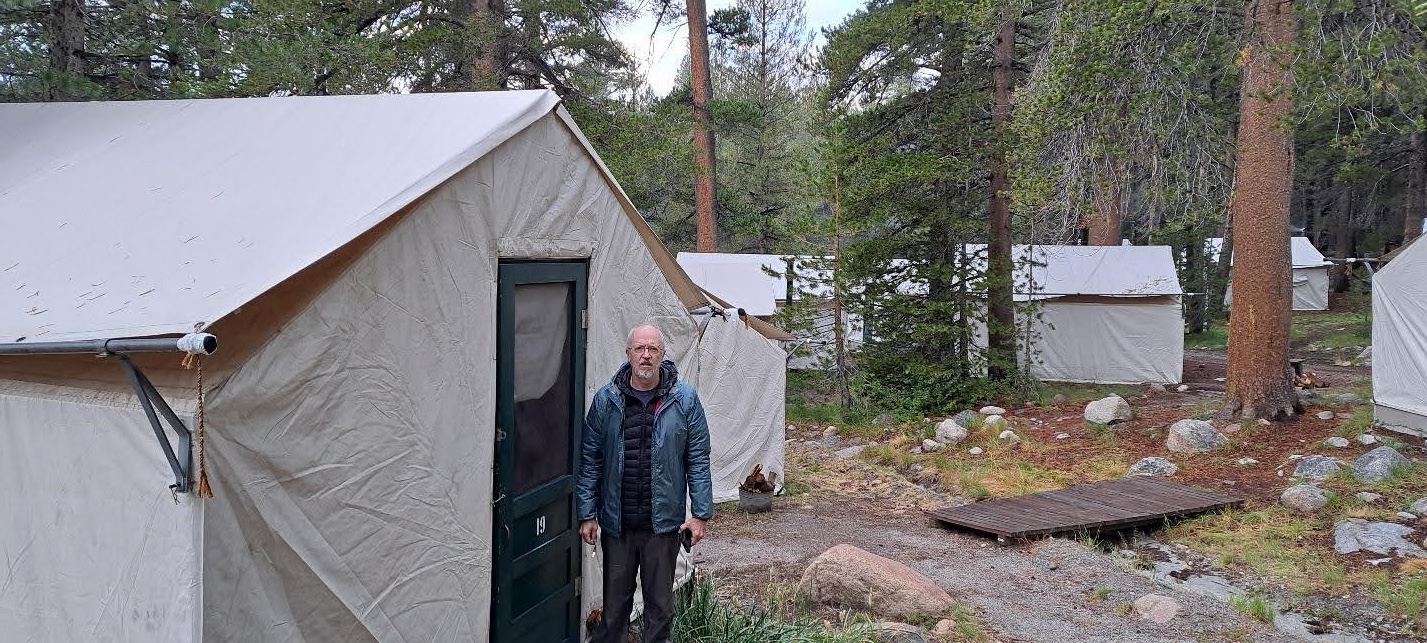
Tent Cabins @ Tuolumne Lodge
Photo provided by Russ Ellsworth
For about a week, our hike took on a Groundhog Day quality to it: get up in the morning, hike over the “pass of the day” (Donohue Pass, Seldon Pass, Silver Pass, Muir Pass, Mather Pass, Pinchot Pass, Glen Pass, Forester Pass, Trail Crest) and down the other side to set up camp and rehydrate supper. We were fortunate to have acquired North-to-South permits for this trip. My biggest fear – Acute Mountain Sickness – never came to pass. At first, whenever I wanted to drink, I had to stop to catch my breath first. But by the time we hit the higher passes to the south, we were well-acclimated to the challenge, and breathing was much more natural. I think the North-to-South itinerary mitigated this danger.
There were disappointments: stargazing, and my chance to see the Milky Way in all its glory was first prevented by the wildfire smoke, then by that giant spotlight that came up over the mountains every night for two weeks. By the time the moon waned, the central core of the Milky Way was well below the horizon before sunset and what I could finally see was a disappointing view of its outer limits.

One of the many passes on the JMT
Photo provided by Russ Ellsworth
The rewards were just as stark. Spectacular waterfalls, high mountain passes, light hitting the mountaintops long before the warming rays of the sun came to defrost my fingers, and lots of interesting fellow-hikers every day. Add some one-time experiences: soaking in hot springs near the Muir Trail Ranch, visiting Devil’s Postpile, and escaping for a day to Mammoth Lake and we had the makings of a memorable experience.


One of the many passes on the JMT
Photo provided by Russ Ellsworth


Evolution Lake | Hot Springs near Muir Trail Ranch
Photo provided by Russ Ellsworth

Devil’s Postpile near Mammoth Lakes and Red’s Meadow
Photo provided by Russ Ellsworth
In the south, “escape” from the JMT becomes progressively harder. Resupply at the wonderfully hiker-friendly Mt. Williamson Motel in the town of Independence was a two day out and back over Kearsarge Pass. Thoughts of bypassing the remainder of the trip were at one point suppressed for no better reason than that getting off the trail was more challenging than continuing on to Mt. Whitney and finishing what we started.
Early on at Yosemite, a ranger named Erich advised us against climbing either Half Dome or Cloud’s Rest due to impending thunderstorms. In retrospect, we were glad we took his advice for another reason: this trail is hard enough for two 67-year-olds without making it harder with unnecessary side treks. It took us 24 days, with one nearo, one zero, and that side trip to Independence. At one point, every step was a new record single-hike distance for Dave, and a new elevation record for me. Dave has climbed Mt. Kilimanjaro, so he will always have me beat there, and my longest LASH was 566 miles, so I hold the advantage there.
This was Dave’s third trip to the peak of Mt. Whitney. His first was in 1963 when he was 5, and the second was a “day hike” just last year. That “day hike” started at 3 am and ended at 11 pm, so hiking to Whitney Portal in daylight was as new an experience for him as it was for me.

Mt. Williamson Motel, Independence, CA
Photo provided by Russ Ellsworth
Did I underestimate this hike? In some ways yes. A trail graded for pack animals sounds benign, but the horses and mules we came across were part equine, part Billy Goat. The daily effort to cover “just” 8 to 14 miles was more than I expected. On the other hand, there are plenty of stories about the dangers of climbing Mt. Whitney – and these dangers are real – but we had no issues with it, again most likely due to us coming from the North and acclimating well.


Mule Train
Photo provided by Russ Ellsworth
In other ways, it was about what I expected. My first thought (“This is 206 miles? That’s two weeks!”) was quickly reset by Dave’s more realistic “3 weeks and then some” agenda. Hiker-friendly switchbacks (and yes, there are 99 of them between Trail Crest and Trail Camp on the Whitney Portal Trail, I was bored and counted them all) make the going easier than they might otherwise have been, and there are no “stow the poles and get ready for some real climbing” ala Mt. Katahdin in Maine.
The turning point probably came after we were no longer congratulating the north-bound hikers for being almost finished, and the north-bound hikers were congratulating us for a job well done.
Despite the freezing mornings, seemingly never-ending climbs (as one hiker put it when we were climbing Mt. Whitney: “How do you eat an elephant? One bite at a time,” to which I later remarked “This Mt. Whitney is one big chewy elephant!”), or the stubbed toe reminding me of its existence every step for four days, I wouldn’t give up the memories of the vistas, the swims in cold Alpine Lakes, or the sense of accomplishment for all the comforts of home. And the JMT can keep the twenty pounds I lost out there.